
Sources: our roof repair page and the Texas Department of Insurance water damage and mold guide (updated April 24, 2025).
To fix a leaking roof, you first have to find where the water actually gets in, and that is rarely the spot right above the stain. Water lands on the roof, slips under a damaged shingle or past a cracked seal, and then runs along the underlayment and the rafters before it drips onto your ceiling. A leak over the living room can start several feet uphill at a vent, a valley or a chimney.
This guide covers what to do the day a leak shows up, how to trace it to the source, the common leak points and the usual fix for each, and when a repair stops being worth it. If you would rather have someone find it for you, our roof repair page explains how our free inspection works.
What's in this guide
- What to do the moment your roof leaks
- How to find where the leak is coming from
- Common leak sources and how each is fixed
- How to stop a leak during heavy rain
- What you can safely do yourself
- When a repair is no longer worth it
- Will insurance pay for a roof leak?
- How we find and fix leaks
- Common questions
What to do the moment your roof leaks
The first job is limiting the damage inside. The Texas Department of Insurance (TDI) puts it simply: stop the water flow as soon as you can, and dry the area as soon as you can, because mold can start growing within a day after a leak.
- Catch the water. Put a bucket or bin under the drip and lay towels around it. Move furniture, rugs and electronics out of the way.
- Watch the ceiling. If drywall is sagging or bulging with water, keep people and pets out from under it. If water is near a light fixture or outlet, turn that circuit off at the breaker.
- Photograph everything. Take photos and video of the stain, the drip and anything that got wet, before you clean up. TDI advises the same for any claim.
- Check the attic if you can do it safely. Look for wet insulation, a dark stain on the decking, or a drip line along a rafter. It tells you roughly where to look on the roof.
- Stay off a wet roof. Wet shingles, metal and tile are slippery, and storms bring wind and lightning. OSHA notes that falls are among the most common causes of serious work-related injuries and deaths, and that is for people with fall protection.
How to find where the leak is coming from
Finding the entry point is most of the work. Patching the shingles directly over the stain is how people end up paying for the same leak twice.
Start inside and work uphill
Go into the attic with a flashlight during or right after rain. Find the wet spot above the ceiling stain, then follow the water trail uphill along the rafter or the underside of the decking. Look for daylight through the boards, rusty nail tips, or darkened wood around a vent pipe or chimney. Measure from a fixed point, such as the chimney or an exterior wall, so you can find the same spot on the roof.
Look at the roof from the outside
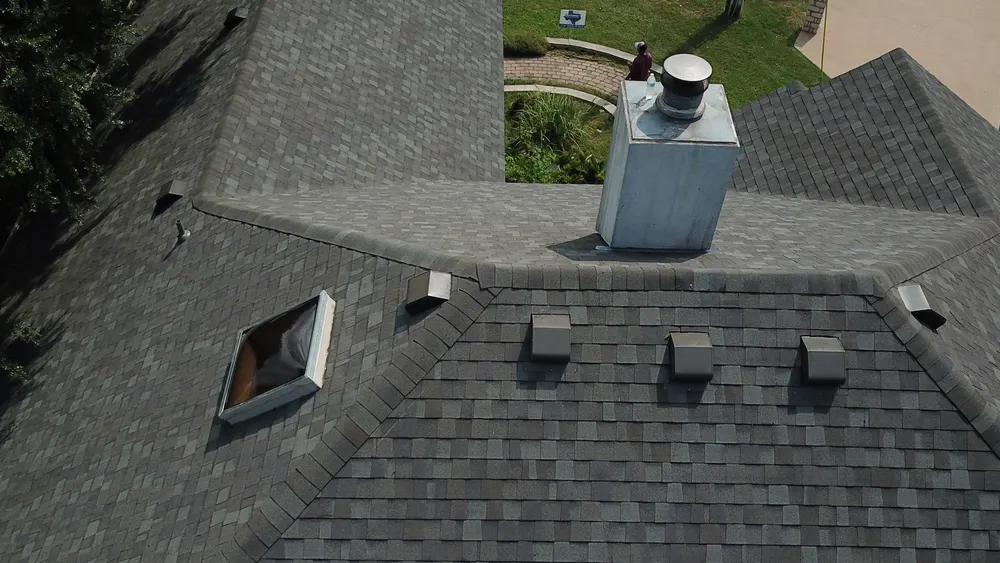
From the ground with binoculars, or from a drone photo, look at the area above where the water showed up and everything uphill of it. Check for missing or lifted shingles, cracked rubber boots around plumbing pipes, gaps in the metal flashing at walls and chimneys, and debris piled in valleys.
The hose test
If nothing is obvious, a hose test can narrow it down on a dry day: one person runs water over one small area of the roof at a time, starting low and moving up, while another watches in the attic. It is slow, and it means someone is on the roof, so it is a job for a roofer on most homes.
Common leak sources and how each is fixed
Most leaks come from a short list of places. On a shingle roof in North Texas, these are the ones we check first:
| Leak source | What you may see | Usual fix |
|---|---|---|
| Pipe boots (plumbing vents) | Stain near a bathroom or kitchen wall; cracked rubber collar | Replace the boot and reseal the shingles around it |
| Chimney and wall flashing | Stain along an exterior wall or beside the fireplace | Reseat or replace step and counter flashing |
| Roof vents and skylights | Drip near a vent or the skylight frame | Reseal or replace the vent or skylight flashing |
| Valleys | Stain where two roof slopes meet | Clear debris; repair or rebuild the valley |
| Missing or lifted shingles | Shingles in the yard; creased tabs after wind | Replace and reseal the damaged shingles |
| Nail pops | Small drip spots, often in cold weather | Reset the nail and replace the shingle above it |
Flashing and pipe boots deserve the extra attention. Sealant dries out in the Texas heat and rubber boots crack in the sun, so these tend to be small repairs that stop a lot of water.
Other roofs fail in their own places. On clay or concrete tile, a leak is very often the underlayment under the tile or the flashing, not the tile itself, which our roofing tile cost guide covers under repair and re-lay. On an exposed-fastener metal roof, the screws and their rubber washers are the usual suspects, as our metal roof cost guide explains.
How to stop a leak during heavy rain
During the storm itself, work from inside. Catch the water, protect what is below it, and wait for the weather to clear before anyone goes up. A roof can be fixed properly in a day or two. A fall cannot be undone.
Once the rain stops and the roof is dry enough to walk safely, a temporary cover can keep more water out until the permanent repair. TDI lists putting a tarp on your roof as a reasonable temporary repair after damage, and says it is generally OK to make temporary repairs before checking with your insurer, as long as you photograph the damage first.
A tarp should run over the ridge and be weighted or fastened so wind cannot get under it. Roofing cement or sealant on a cracked boot or an open seam can also buy time. Treat both as a stopgap, not a fix.
What you can safely do yourself
Some of the work can be done without going on the roof:
- Trace the leak in the attic and mark the spot.
- Clean out gutters and downspouts from a ladder, so water drains off the roof edge instead of backing up.
- Look over the roof from the ground after every big storm and note anything missing or out of place.
- Trim limbs that rub on the roof or drop debris into the valleys.
Replacing a single shingle or a pipe boot is within reach for some homeowners on a low, single-story roof. The hard part is not the shingle. It is getting the seal right on the shingles around it, matching an older shingle, and finding the real entry point in the first place. On steep roofs, two-story homes, tile and metal, call a roofer.
On permits, the City of Fort Worth's roofing FAQ says replacing only the shingles on a single-family home does not need a permit, but replacing any decking does. Other cities nearby set their own rules, so check with yours if the repair goes down to the boards.
When a repair is no longer worth it
A repair makes sense when the problem is local and the rest of the roof is sound: one leak, one wind-damaged section, one bad piece of flashing. It rarely makes sense when the shingles are brittle and shedding granules on every slope, or when you are on your second or third leak in as many seasons. At that point each repair buys less time.
If you are weighing a new roof, our roof replacement cost guide shows what a full replacement costs and how to estimate the size of your own roof.
Will insurance pay for a roof leak?
It depends on what caused it. TDI says most homeowner policies cover sudden and accidental water damage, but usually will not cover damage from gradual leaks. Its guide to what home policies won't cover adds that companies don't pay for damage that happens over time, such as worn roofs. A leak that starts after a hail or wind storm is a different situation from one that has been seeping for months.
Your policy decides the details, so ask your agent. If a storm caused the leak, our storm damage roofing page explains how the inspection and the insurance side work. The claim is between you and your insurance company, and the decision to file is yours.
How we find and fix leaks
At Bluebonnet Construction & Roofing, owner Cody Taylor does every inspection himself. He starts from the stain inside, then works uphill on the roof, checking the flashing, pipe boots, vents and valleys above it until he finds the entry point. He looks at the whole roof, not only the area over the stain, because a leak that keeps coming back often has more than one way in.
He shows you what he finds, and the written estimate for the fix comes to your email. If a repair will hold, that is what we recommend. If the roof is worn past the point where a repair makes sense, he will tell you that too. The inspection is free.
If water is coming through the ceiling now, call us and tell us it is an emergency. The first job is to stop more water getting in. We are based in Aledo and fix leaks in Weatherford, Hudson Oaks, Willow Park, Fort Worth and the rest of our service area. Request a free inspection on our roof repair page.
Sources: TDI, "When are water damage and mold covered by insurance?" (updated April 24, 2025); TDI, home damage FAQ (updated September 15, 2025); TDI, "What your home policy won't cover" (updated April 10, 2025); OSHA fall protection; City of Fort Worth roofing FAQ (revised June 2025).
FAQ
Who is the best person to fix a leaking roof?
A roofing company that will inspect the whole roof and show you where the water gets in before quoting a fix. A handyman can patch a spot, but a leak is often several feet from the stain, and the person who finds the real entry point is the one who stops it.
What do you do when your roof is leaking?
Catch the water and move belongings out of the way, keep people out from under a sagging ceiling, turn off power near wet fixtures, and photograph the damage. The Texas Department of Insurance says to stop the water and dry the area as soon as you can, because mold can start within a day. Then have the roof inspected once the weather clears.
How do I stop my roof leaking in heavy rain?
Work from inside during the storm: catch the water and protect what is below it. Do not go on a wet roof. Once it is dry and safe, a tarp over the area or roofing sealant on a cracked boot or seam can keep water out until a permanent repair. Photograph the damage before any temporary fix.
What is the most effective way to fix roof leaks?
Find the true entry point first, usually by tracing the water uphill in the attic, then repair that spot properly: a new pipe boot, reseated flashing, replaced shingles or a rebuilt valley. Sealant over the stain area alone tends to fail, because the water usually gets in somewhere else.
Does homeowners insurance cover a leaking roof?
It depends on the cause and your policy. The Texas Department of Insurance says most home policies cover sudden and accidental water damage but usually not gradual leaks, and companies do not pay for wear such as a worn roof. A leak caused by a storm is treated differently from one that has been seeping for months. Ask your agent.
Can you repair just part of a roof?
Yes, when the damage is local and the rest of the roof is sound. One leak, a wind-damaged section or one bad piece of flashing can usually be repaired on its own. When the shingles are worn across every slope or leaks keep showing up in new places, a replacement is often the better use of the money.