
Source: This Old House new roof cost guide (updated October 7, 2026). Lifespans assume a properly installed roof; the underlayment under the tile usually needs attention sooner.
The main roofing tile types are clay (including terracotta), concrete and natural slate, with synthetic, metal and solar tiles as newer options. Each of those comes in several profiles, from round barrel tile to flat tile that looks like slate or wood shake, and in a wide range of colors. Clay and concrete are by far the most common on homes around Fort Worth, and they look alike from the street, but they are made differently, weigh differently and age differently.
This guide explains each type, the shapes and colors they come in, and the trade-offs that matter in North Texas. If you already have a tile roof that needs work, our tile and slate roofing page explains how we inspect one.

What's in this guide
- Roofing tile types by material
- Tile shapes and profiles
- Roofing tile colors and finishes
- Tile types compared
- Are tile roofs a good choice?
- Tile roofs in the North Texas climate
- How we work on tile roofs
- Common questions
Roofing tile types by material
Clay tile
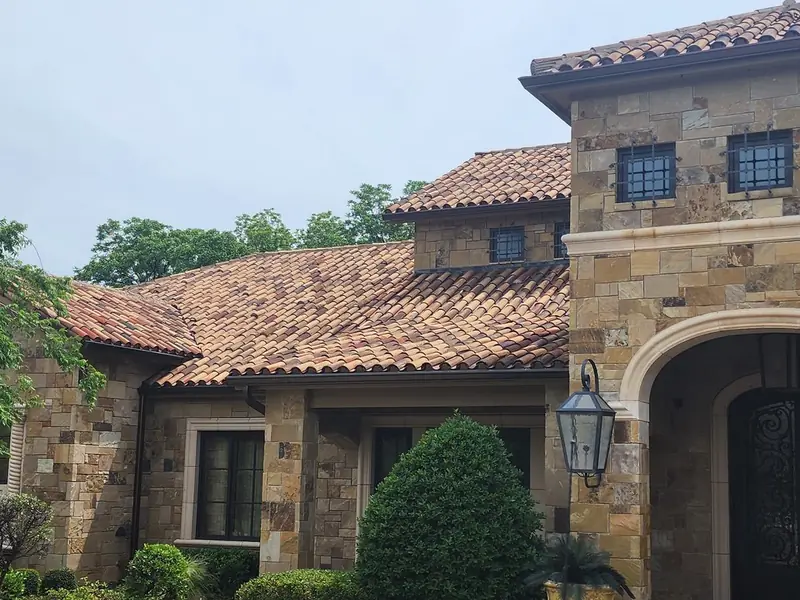
Clay tile is made by filling molds with wet clay and firing them in a kiln until hard. This Old House says clay tile roofs can last more than 100 years when installed properly, resist fire, wind and hail, and are heavy enough that the roof may need extra structural support. Terracotta is the classic orange-red fired clay most people picture on Spanish and Mediterranean-style homes.
Concrete tile
Concrete tile is a mix of sand, cement, water and iron oxide, molded by machine. This Old House calls it a more affordable alternative to clay, with a Class A fire rating and more variety in styles and colors. Modern concrete tile can mimic clay, wood shakes, slate and stone. The trade-offs are that it is also heavy, and that clay generally keeps its color better over the years.
Natural slate
Slate is natural stone, split into thin pieces and hung on the roof one at a time. It suits Tudor and French-style homes and is one of the longest-lasting roofs there is, but it is heavy, expensive and slow to install and repair.
Synthetic, metal and solar tile
Synthetic or composite tiles are made from polymers and recycled materials to look like slate or shake while weighing less. The Metal Roofing Alliance lists metal tile, metal slate and metal shake among residential metal roof styles. Solar tiles generate electricity and sit flush with the roof, but This Old House notes they cost more than traditional solar panels.
Tile shapes and profiles
Within each material, the profile of the tile sets the look of the roof:
- Barrel or mission tile. Round, half-cylinder tiles laid alternately facing up and facing down. The look of Spanish missions and Mediterranean homes.
- Spanish or S tile. A single tile with an S-shaped curve that gives the barrel look with one piece instead of two.
- Flat tile. No barrels or rolls. Flat tile can be made double-thick to imitate wood shakes, or thin and smooth to imitate slate.
- Interlocking tile. Tiles that overlap and lock on their sides. This Old House says they are easy to install and suit lower-pitched roofs.
This Old House's tile cost guide also lists French, pantile and Riviera profiles, which are variations on these with different curves and ribs. The profile matters when a roof needs repair, because a replacement tile has to match the shape of its neighbors as well as the color.
Roofing tile colors and finishes
Clay tile color comes from the clay itself and from any glaze. This Old House says clay tiles come in matte, glossy or metallic finishes and can be coated in nearly any color, and that the clay recipe decides the range a maker can produce. Natural terracotta, buff and brown are the traditional choices. Blends of two or three shades are common on a single roof, which gives it a weathered look from day one.
Concrete tile gets its color from iron oxide pigments, so it comes in earth tones, pastels and multicolor blends. This Old House notes that clay keeps its color better than concrete over the years.
Color also affects heat. The EPA lists terra cotta tile as naturally cool, and lists lighter or cool-color glazes and reflective coatings as cool roof options for tile. In a Fort Worth summer, a lighter tile can take some load off the air conditioning.
Tile types compared
| Type | Made of | Expected lifespan | Good to know |
|---|---|---|---|
| Clay | Kiln-fired clay | 50 to 100 years | Heavy; holds color well |
| Concrete | Sand, cement and pigment | 50+ years | Heavy; lowest-cost tile; many styles |
| Natural slate | Split stone | 75 to 150 years | Heaviest and costliest; slow repairs |
| Synthetic | Polymers, recycled material | Varies by product | Light; mimics slate and shake |
| Metal tile | Formed, coated steel or aluminum | Varies by product | Light; looks like tile or shake |
Sources: This Old House new roof cost guide (updated October 7, 2026) for lifespans; clay tile roof guide (updated June 5, 2026) and concrete tile roof guide (updated May 27, 2026) for materials.
Are tile roofs a good choice?
For the right house, yes. Tile lasts a very long time, does not burn, and gives a Spanish, Mediterranean or Tuscan home the roof it was designed for. The downsides are real, though, and worth knowing before you buy a home with tile or put tile on one:
- Weight. This Old House puts clay tile at 700 to 1,000 pounds per roofing square (100 square feet). A house that has had shingles needs its framing checked before it can take tile.
- Cost. Tile costs more to buy and to install than asphalt shingle. Our roof replacement cost guide compares the two.
- Brittleness. Tiles crack when someone steps in the wrong place, and hail and falling limbs break them too.
- Underlayment. The tile lasts for decades, but the underlayment under it often wears out first. Many tile roof leaks are an underlayment or flashing problem, not a tile problem.
If the downsides outweigh the look for you, our guide to tile to tin roofing covers what it takes to switch a tile roof to metal.
Tile roofs in the North Texas climate
Tile's biggest weather weakness is the freeze-thaw cycle. This Old House notes that clay and concrete do poorly where water soaks in and freezes over and over, which is a bigger problem farther north than in Fort Worth. Here the tests are summer heat, wind and hail.
Heat favors tile, especially light or terracotta tile. Hail is the risk: a large hailstone can crack tile, and a cracked tile lets sun and water reach the underlayment. The Texas Department of Insurance says roofing materials tested for impact resistance, tiles included, are rated Class 1 to 4, with a Class 4 covering getting the highest premium credit from insurers that offer one (TDI roofing discounts, as of February 24, 2023). Ask for the rating of any tile you are considering.
How we work on tile roofs
At Bluebonnet Construction & Roofing, owner Cody Taylor inspects every tile, slate and copper roof himself. The inspection looks for cracked, slipped and missing tiles, checks the flashing at walls, chimneys and valleys, and, where possible, looks at the underlayment, because on clay tile it so often decides whether a repair will hold. Part of the estimate is talking through how close a match is possible for your tile's color and profile.
If a repair will hold, that is what we recommend. If the tile is fine but the underlayment is not, we explain what lifting the tile and re-laying it would involve on your roof. The inspection is free, and the written estimate comes to your email.
We take tile roof calls in Aledo, Benbrook, Granbury and Fort Worth. To set up an inspection, visit our tile and slate roofing page.
FAQ
Are tile roofs any good?
Yes, for the right house. Clay and concrete tile last for decades, resist fire and suit Spanish and Mediterranean-style homes. The trade-offs are weight, a higher price than shingle, tiles that crack if walked on carelessly, and an underlayment that usually needs replacing long before the tile does.
What is the life expectancy of a tile roof?
This Old House gives clay tile an expected lifespan of 50 to 100 years, concrete tile 50 years or more and natural slate 75 to 150 years. Those figures are for the tile. The underlayment beneath it often wears out sooner, which is why many older tile roofs leak while the tiles still look fine.
What are the disadvantages of tile roofs?
Tile is heavy, at 700 to 1,000 pounds per 100 square feet for clay according to This Old House, so the framing has to be able to carry it. It costs more than shingle, breaks under foot traffic and hail, and is slower to repair because replacement tiles have to match the shape and color.
What are the different types of concrete roof tiles?
Concrete tiles come in flat, low-profile and high-profile curved shapes. Because they are molded and colored with iron oxide, they can be made to look like clay barrel tile, wood shakes, slate or stone, in earth tones, pastels and multicolor blends.
What colors do roofing tiles come in?
Clay tile comes in natural terracotta, buff and brown tones, plus glazed finishes in matte, glossy or metallic and nearly any color. Concrete tile comes in a wide range of pigmented colors and blends. Lighter colors and terra cotta stay cooler in the sun, according to the EPA.
Can you walk on a tile roof?
Only carefully, and ideally only a roofer who knows where to step. Tiles crack when weight lands in the wrong place, which is a common way tile roofs get damaged during satellite, solar or AC work.